In a memory experiment, people studied photographs of rooms and then drew what they remembered. Participants with aphantasia drew fewer objects and used less colour than the comparison group. Yet the objects they did draw were positioned with similar spatial accuracy. When copying the photographs directly, the groups did not show the same differences.
That finding, reported by Wilma Bainbridge and colleagues, captures the puzzle: someone can retain information about a scene without experiencing a picture of it. Remembering where the chair stood and mentally seeing the chair are separable achievements.
Aphantasia turns an ordinary instruction, picture an apple, into a surprisingly difficult question. Are you asking someone to produce a visual experience, retrieve facts, or simply think about the fruit? Those can feel like the same activity until people compare what actually happens inside their minds.
The short answer
People can think, remember, and solve problems without voluntary visual mental pictures. Aphantasia usually refers to absent or markedly reduced imagery of this kind. It concerns a particular aspect of experience, not an absence of consciousness or thought.
The research does not support one simple replacement mechanism. Some tasks can be approached through words, spatial relationships, or other strategies. Some reveal differences in the details people recall. And people who share the label do not necessarily share an identical inner life.
The useful question is therefore more precise than whether someone has an imagination: what information can they use, what does using it feel like, and how are the two related?
What does aphantasia describe?
Adam Zeman, Michaela Dewar, and Sergio Della Sala introduced the term in a 2015 report describing 21 people with lifelong reductions in visual imagery. Several had only realised that their experience differed from others through conversation or reading.
The word voluntary is essential. The report distinguished deliberately summoning an image from imagery that arrives unbidden. A person may struggle to picture something on request yet describe visual dreams or occasional spontaneous images. A statement about one ability does not automatically cover every mental state.
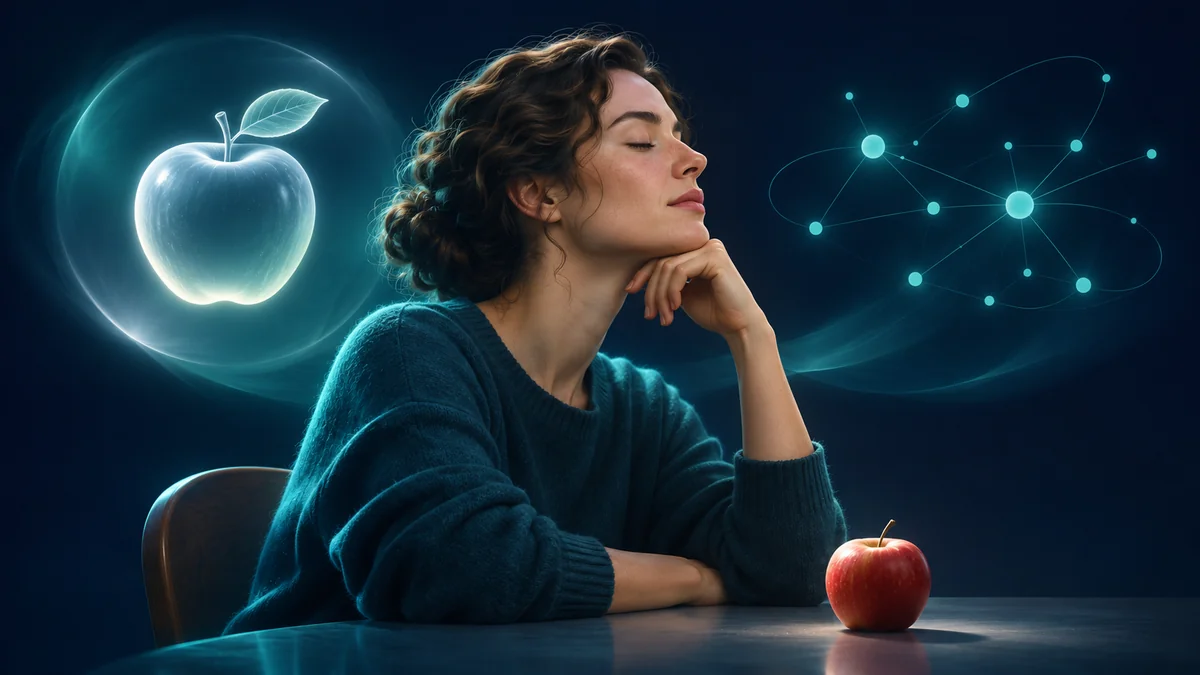
Consider this illustrative example. Asked about an apple, one person experiences an image with colour and shape. Another can explain that an apple is rounded, has a stalk, and may be red, without a visual impression. Both answers contain knowledge. Only the first description includes deliberately generated visual experience.
That example is a teaching aid, not a diagnostic test or a claim that everyone fits one of two boxes. A drawing of an empty square is also a poor literal portrait of aphantasia: it can wrongly suggest that the person experiences a black screen where other people see a picture.
| Question | What it asks about | Illustrative example |
|---|---|---|
| What do you know? | Information available to thought | Knowing that an apple has a stalk |
| What can you do? | Performance on a particular task | Placing remembered objects in a room |
| What do you experience? | The felt qualities of thinking | Having, or not having, a visual impression |
How can scientists check a private experience?
Questionnaires ask people to describe the vividness of imagined scenes. These reports are indispensable because the question concerns experience. But a rating alone cannot tell researchers whether people interpret an instruction or a scale in the same way.
In a 2018 study, Rebecca Keogh and Joel Pearson used binocular rivalry. When different patterns are presented to the two eyes, perception can favour one over the other. Imagining a pattern beforehand can bias which one is subsequently reported.
The self-described aphantasic participants showed almost no imagery-based priming in that experiment. This supplied evidence beyond a questionnaire: the reported difference was accompanied by a difference in an indirect sensory measure.
The result supported the authors' interpretation of reduced sensory imagery. It did not make every later question about mental representation disappear. A task measures a particular effect under particular conditions; it does not open a window through which a researcher can inspect every thought.
What pupils reveal, and what they do not
Pupils change size in response to light. A 2022 study by Lachlan Kay and colleagues examined a subtler effect: pupil changes while people imagined previously viewed bright or dark shapes.
The researchers found imagery-related differences in participants with visual imagery. Their aphantasia group did not show significant evidence of that imagery light response, while still responding to actual light and to increased cognitive effort. The contrast supported a difference in imagery rather than a simple failure of the pupils to react.
But this is not a finished universal test. In a paper published online on January 29, 2026, Daniel Gardner and colleagues found that imagined brightness could influence pupils, but the size of that effect did not reliably track differences between people's vividness ratings.
These are related but different questions. An effect can occur during imagination without reliably ranking individuals by how vivid their imagination feels. The newer result cautions against presenting pupil measurements as a dependable imagery thermometer.
For a reader, the distinction is practical: an appealing biological marker is not automatically a validated individual classification tool. Researchers need to establish what it measures, how consistently it does so, and which alternative explanations remain.
Remembering without a mental photograph
The room-drawing study included 61 participants with aphantasia and matched controls. Its most informative feature was the comparison between drawing from memory and copying a visible scene. That helped separate memory differences from an overall inability to draw.
The aphantasia group also relied more on verbal labels. Together with the preserved positioning of remembered objects, this suggests that visual details, spatial relationships, and verbal descriptions need not all depend on the same kind of representation.
It would be an overreach to conclude that every memory is worse, or that spatial ability is always unaffected. The finding concerns particular measures in a particular task. A useful account preserves that specificity.
A separate 2021 study by Keogh, Marcus Wicken, and Pearson reported retained accuracy and capacity on visual working-memory tasks, alongside differences in strategy. Working memory is the short-term retention used while completing a task, rather than remembering an event from years ago.
Here is an analogy, not a proposed brain mechanism: two people could find a destination using different representations, one consulting a picture-like map and another following a sequence of directions. Similar success would not establish identical experience. Different success on another route would not make either representation useless.
This also connects to a broader lesson about memory and reconstruction: describing memory as a photograph can obscure the different kinds of information it contains.
Does it affect dreams and other senses?
In a 2020 survey, Alexei Dawes and colleagues found that participants with aphantasia reported differences extending beyond voluntary visual imagery. As a group, they described less vivid autobiographical recollection and imagined future events, and fewer or less sensory-rich dreams.
Some also reported reduced imagery in other senses, but this was not universal. Visual imagery, imagined sound, and other sensory experiences should not be treated as a single switch that must be either on or off.
The survey's evidence is about what participants reported. It does not establish that all people with aphantasia dream alike, or that someone without vivid recollection lacks knowledge of their past. Knowing what happened and feeling as though one is reliving it are different descriptions.
Research on communication with dreamers offers a complementary reminder: the circumstances under which an experience occurs affect how scientists can investigate it. Asking about deliberate imagery while awake is not the same experiment as asking about a dream.
Can a story still evoke emotion?
A 2021 experiment by Wicken and colleagues compared physiological responses to frightening stories. They measured skin conductance, an index of bodily arousal, while participants read and imagined the scenarios.
The aphantasia group showed a dampened response to the stories. In a second experiment with frightening pictures, the same group difference was not found. The contrast supported the idea that visual imagery can amplify responses to imagined situations.
That is much narrower than saying people with aphantasia lack emotions, cannot enjoy fiction, or never become afraid. A physiological response during one reading task is not a complete inventory of a person's emotional life.
When thinking about a novel, it helps to separate several possible ingredients: following events, understanding motives, responding to language, and experiencing an imagined scene. The experiment concerns the contribution of imagery. It does not show that imagery is the only route into a story.
What does brain imaging add?
In a 2025 study, Jianghao Liu and colleagues used high-resolution 7-tesla functional MRI with 10 typical imagers and 10 people with aphantasia. Tasks covered shapes, colours, words, faces, and spatial relationships.
Imagery tasks recruited similar visual areas in the two groups, but the aphantasia group showed reduced functional connectivity between a region in the left fusiform gyrus and frontoparietal areas. Functional connectivity describes a statistical relationship between activity signals; it is not a direct measurement of messages travelling along a wire.
The result suggests that activity in a visual area alone may not explain whether a person has visual imagery experience. How regions work together may also be relevant.
The sample was small, and the study does not identify a universal cause or a single broken connection. Nor does activation prove that a participant secretly experienced an image. The distinction between information represented in the brain and information consciously experienced is exactly what needs explaining.
A newer challenge: what counts as seeing?
A March 25, 2026 survey study by D. Samuel Schwarzkopf and colleagues examined how people describe their imagery. The authors found that vividness ratings related to a broad range of reported experiences, but that many respondents described mental depictions without saying they actually saw them.
They proposed distinguishing faint or unseen mental images from a complete lack of pictorial representation. This is a proposal about how to characterise variation, not evidence that everyone previously describing aphantasia was mistaken.
It highlights a genuine measurement problem. One person may reserve the word seeing for something almost perceptual. Another may use it for a much less vivid internal experience. Asking for concrete descriptions alongside ratings can help researchers understand what those answers mean.
Better definitions could change which people are grouped together in an experiment. That, in turn, could help explain why different tasks and samples do not always produce a single tidy pattern.
What aphantasia teaches about consciousness
Aphantasia is a reminder to distinguish the contents of consciousness from the abilities of the person having them. A difference in mental pictures does not establish a difference in whether someone is conscious, intelligent, or fully engaged with the world.
The evidence also challenges a tempting inference: if two people give the same answer, they must have arrived at it through the same internal experience. Performance can conceal differences in strategy and phenomenology, the qualities of experience as they feel to the person.
The converse mistake is equally tempting. If two people describe different experiences, we might assume that everything about their thinking differs. The research instead calls for narrower questions about particular tasks, memories, and sensory qualities.
The next useful advances will combine clearer first-person descriptions with repeatable behavioural and physiological measures. A stronger study would ask whether a finding survives different instructions and task demands, rather than treating any one score as the final answer.
For now, the conclusion is both modest and striking: knowing about something, using information about it, and mentally seeing it are not interchangeable. Understanding that separation gives consciousness research a sharper question than whether the mind contains pictures.
Common questions
Does aphantasia mean having no imagination?
No. Here, the term concerns voluntary sensory imagery, especially visual imagery. Creating ideas or reasoning about possibilities is a broader activity.
Can someone with aphantasia have visual dreams?
Yes. Reports of visual dreams can coexist with absent voluntary visual imagery. Experiences vary, so the label does not predict every person's dreams.
Does it mean having a bad memory?
Not as a blanket statement. Studies distinguish object details, spatial relationships, working memory, and the felt vividness of recollection. Results in one domain do not settle the others.
Is imagining an apple enough to identify it?
It can start a useful conversation, but it is not a complete assessment. Instructions, subjective interpretation, task performance, and the limits of physiological measures all need consideration.
Sources and further reading
- Zeman, Dewar, and Della Sala (2015), Cortex. Original report introducing the term aphantasia.
- Keogh and Pearson (2018), Cortex. Binocular-rivalry evidence about sensory imagery.
- Kay and colleagues (2022), eLife. Imagined brightness and pupil responses.
- Gardner, Saurels, and Arnold (2026), Cortex. Limits of pupil responses as an index of individual vividness.
- Bainbridge and colleagues (2021), Cortex. Object and spatial memory measured through drawing.
- Keogh, Wicken, and Pearson (2021), Cortex. Working-memory performance and strategy.
- Dawes and colleagues (2020), Scientific Reports. Self-reported multisensory imagery, memory, and dreams.
- Wicken, Keogh, and Pearson (2021), Proceedings of the Royal Society B. Physiological responses to frightening narratives and images.
- Liu and colleagues (2025), Cortex. High-resolution brain imaging during imagery and perception.
- Schwarzkopf and colleagues (2026), Royal Society Open Science. Vividness ratings and varied descriptions of internal imagery.