What Is Mind Uploading and Whole Brain Emulation?
Strip away the science fiction and the technical proposal is this: scan a brain's full wiring diagram, its connectome, along with enough detail about how each connection behaves, and use that data to run a computer simulation that processes information the same way the original brain did. If the simulation is accurate enough, the idea goes, it would think, remember, and respond exactly as the original person would.
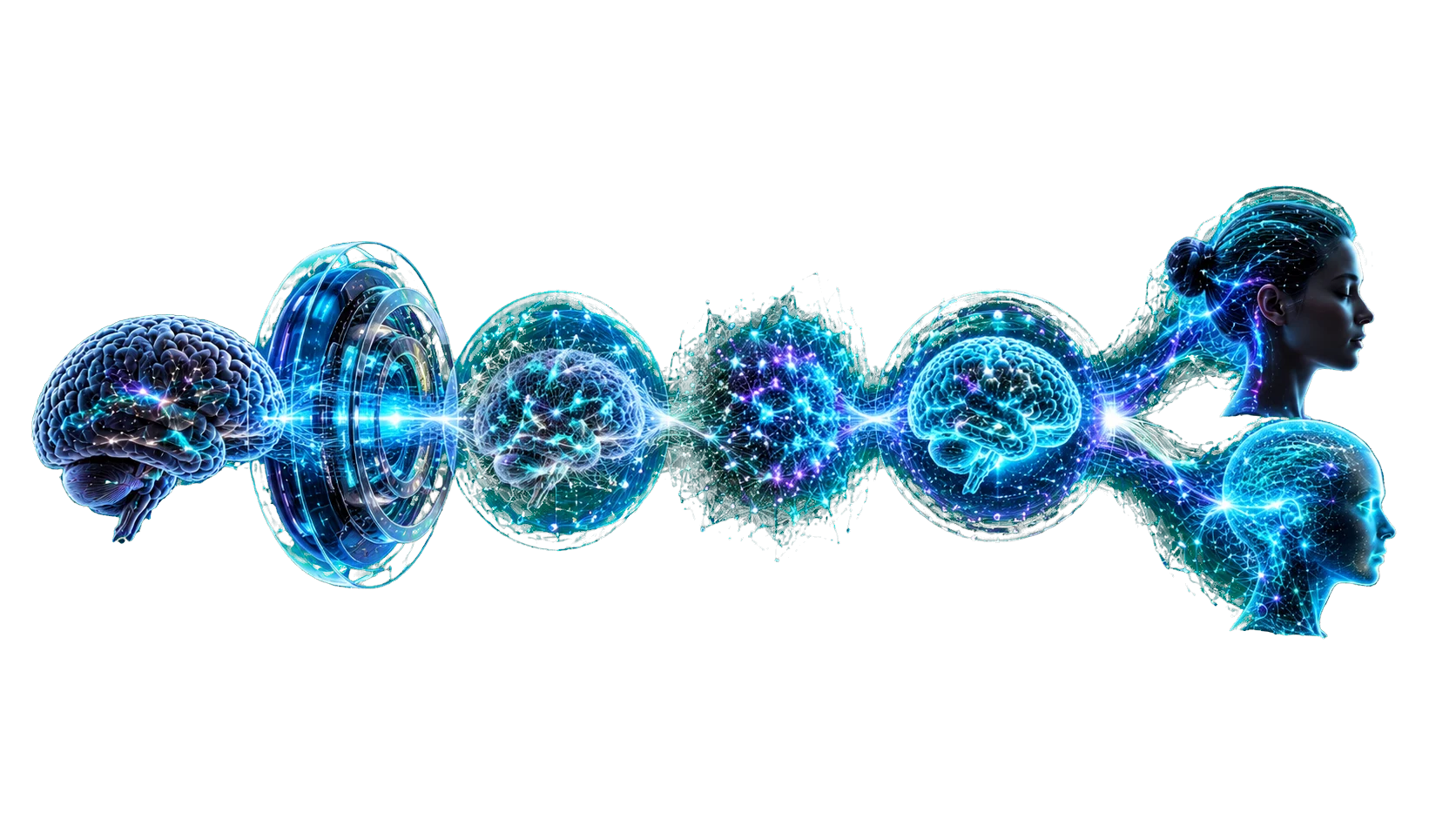
This is genuine, ongoing research, not pure fantasy. Nonprofits like the Carboncopies Foundation coordinate work in this space, including recent workshops on turning raw brain-scan data into functional models and improving memory-decoding techniques. Complete synaptic-resolution connectomes now exist for small organisms such as fruit flies. In mice, researchers have reconstructed exceptionally detailed volumes of brain tissue, but not a complete mouse connectome.
Imagine trying to recreate a specific, fully functioning city, not just its street map, but every business, relationship, and daily routine, purely from an extremely detailed satellite photo. Current brain scanning is roughly at the "very good satellite photo" stage: astonishing spatial detail, but a huge gap remains between having the map and having the living, functioning system the map describes.
The actual timeline, not the hype
A field assessment published in October 2025 identified major unresolved bottlenecks in brain recording, connectomics, structure-to-function inference, and validation. It did not provide a reliable date for human whole-brain emulation.
What's realistically closer: partial brain models built for specific medical uses, understanding a particular disease process or drug effect, rather than a complete simulation of one specific person's entire mind.
Cryonics: what it actually preserves
Cryonics is the practice of cooling a body or brain to very low temperatures shortly after legal death, with the stated goal of preserving its structure until future medicine could, in theory, repair the damage and revive the person. As of the August 2026 review, provider Alcor reported roughly 1,500 members and several hundred patients in long-term storage. The Cryonics Institute and European providers such as Tomorrow Biostasis operated on similar models.
Here is the honest technical status from the August 2026 review: vitrification techniques could reduce the ice-crystal damage that would otherwise destroy tissue, and structural detail could be preserved for long periods. No demonstrated method existed for reversing cryonic preservation and restoring a working, conscious human mind. Cryonics therefore remained a bet on future revival science rather than a technology that included revival.
Can Human Consciousness Be Uploaded?
Even if scanning technology and revival techniques both became perfect tomorrow, there's a deeper question sitting underneath both approaches, and it's philosophical, not technical.
This is sometimes called the teleporter problem, and it applies directly to brain uploading. A copy, however perfect, has no established mechanism connecting your specific, ongoing subjective experience to that of the copy. It would think it is you and retain every memory you had. When this page was reviewed in August 2026, neuroscience had no established test for whether uploading consciousness would preserve continuity of consciousness rather than create a convincing new person. The problem runs straight back into the hard problem of consciousness: subjective experience cannot be detected directly in the copy or the original.
Cryonic revival has a somewhat better claim here, since it would (if it worked) involve the same physical brain rather than a copy, more like waking up from a very long, very cold sleep than being duplicated. But that claim only holds if revival preserves the actual causal continuity of the original tissue closely enough, which is precisely the part that hasn't been demonstrated yet.
What this means for "digital immortality" products
Some services offer to build an AI model trained on someone's writing, voice, and conversation style, sometimes marketed using language like digital immortality or an AI clone. These can be valuable as legacy tools that preserve someone's voice and patterns for the people who care about them. They are not, by any account neuroscience had established at the August 2026 review, a continuation of that person's subjective experience. The distinction mirrors the uncertainty discussed in the guide to AI consciousness and machine sentience.
The bottom line
As of August 2026, mind uploading and cryonics were real areas of research and advocacy, but neither had a demonstrated path to continuing a person's subjective experience rather than producing something that looks, from the outside, like that person continuing. That is not a reason to dismiss long-term research. It is a reason to separate current evidence from a confident survival timeline.