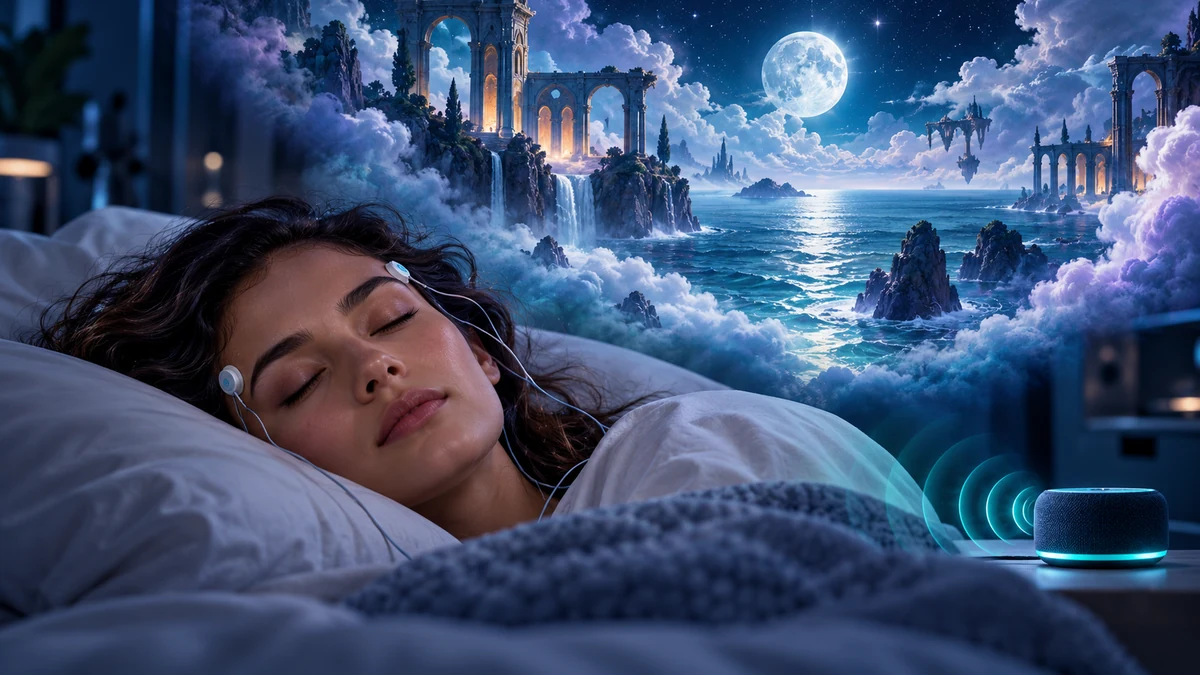
A sleeping person hears a maths problem and sends back the answer with movements of their eyes. They do not sit up, speak, or open their eyes. According to the laboratory recordings, they are still in rapid eye movement sleep.
That is the remarkable core of a 2021 experiment on communication with lucid dreamers. Across four laboratory groups, researchers tested 36 people and recorded 29 correct answers from six of them. The finding is real, but its scale matters: it demonstrates a fragile experimental ability, not a dependable conversation service.
The intriguing question is what this small opening could let scientists investigate. Instead of waiting until morning to ask about a dream, could they ask a carefully chosen question while the experience is unfolding?
The short answer
Yes, under particular experimental conditions, scientists have exchanged information with people who were dreaming. The best evidence concerns lucid dreams, in which someone recognises that they are dreaming while remaining asleep. Responses use an agreed code, such as eye movements, rather than ordinary speech.
Two claims must remain separate. Demonstrating that communication can happen is an existence claim. Demonstrating that it happens reliably, with typical sleepers and open-ended questions, is a much bigger performance claim. The studies discussed here establish the first much more clearly than the second.
A useful way to read this research is to ask three questions at every step: was the person asleep, did a meaningful signal pass between them and the experimenter, and what does that signal actually reveal about their experience?
Dreaming, lucidity, and being awake
Consciousness here means having an experience: seeing a scene, feeling an emotion, or hearing something from a first-person perspective. Wakefulness describes a physiological and behavioural state. These concepts overlap in everyday life, but a dream already illustrates why they are not interchangeable.
Lucidity adds a particular kind of self-awareness. A person can experience a dream without recognising its nature. In a lucid dream, they identify the experience as a dream. That insight is conceptually different from controlling every detail of the scene or remembering everything afterwards.
In Ursula Voss and colleagues' 2009 study, trained volunteers used agreed eye movements to mark lucidity. The researchers described a combination of dream experience and reflective awareness. Their influential interpretation was that lucid dreaming showed features of both waking and ordinary REM sleep. Later work challenged part of the physiological evidence behind that interpretation, as we will see.
REM stands for rapid eye movement. It is a sleep stage identified using physiological recordings, not a synonym for all dreaming. Francesca Siclari and colleagues' 2017 research examined dream reports after awakenings from both REM and non-REM sleep. Reports of experience were associated with changes in activity in posterior brain regions in both states.
So the absence of lucidity does not mean the absence of consciousness. Nor does the presence of a dream tell us which sleep stage someone is in. Those distinctions keep a striking result from turning into an exaggerated claim.
How a dreamer sends a signal
The essential trick is to agree on a response before sleep. That gives the researcher a way to distinguish an intended message from an unexplained movement.
In a foundational 1981 paper, Stephen LaBerge and colleagues reported that five selected participants signalled awareness of dreaming during REM sleep. Their signals followed a pre-sleep agreement and had observable physical counterparts. This made it possible to connect an event reported from inside a dream with a time on a laboratory recording.
That distinction is easy to underestimate. An account given after waking says that something happened at some point. A recognisable signal supplies a potential time marker. Researchers can then ask what the brain and body were doing around that marker.
Consider the logic of a code rather than its particular form. A movement has no inherent meaning of “I know I am dreaming.” The meaning comes from the agreed instruction, its timing, and the evidence that the participant followed it. Without those checks, an attractive-looking trace is just a trace.
Signalling lucidity is still different from answering a new question. A person might remember and perform a rehearsed action without receiving anything new from outside. Two-way communication therefore requires an additional test: information must enter during sleep and influence the reply.
What the two-way experiment established
In the 2021 study, experimenters delivered questions or tasks using sensory cues. Participants replied through distinctive eye movements or facial muscle contractions. Some tasks involved simple arithmetic; others involved yes-or-no answers. Sleep recordings and independent scoring helped assess whether the exchanges occurred during REM.
Across 158 attempts during signal-verified lucid dreams, 29 responses were classified as correct. Most attempts produced no response, and others were incorrect or ambiguous. These are counts of trials, not percentages of people who can do this. The result supports limited communication while dreaming, without showing that every attempt, person, or question will work.
The strongest interpretation is therefore specific: under monitored conditions, some dreamers can receive information and produce a meaningful response. A stronger headline about freely interviewing anyone in their sleep would need stronger evidence.
To understand the experimental challenge, imagine designing the next question. A yes-or-no reply is economical, but tells you little. A more detailed answer offers richer information, yet creates more opportunities for an unclear signal or misunderstanding. Researchers have to balance how much they want to learn against how much the response system can establish.
Could they simply have woken up?
This is an essential alternative explanation, not an objection that can be dismissed because the result is exciting. If a person wakes briefly, answers, and falls asleep again, the exchange does not establish communication during a dream.
Sleep experiments use several recordings together. EEG measures electrical activity at the scalp, eye sensors track eye movements, and muscle recordings help identify changes in muscle activity. This combined approach is called polysomnography. It gives researchers evidence beyond a participant saying they were asleep.
There is also a subtler debate: should lucid dreaming be understood as a blend of waking and sleep, or as an unusual form of REM sleep? The 2009 study proposed the former. Benjamin Baird, Giulio Tononi, and Stephen LaBerge's 2022 analysis challenged that reading of the EEG.
They examined 14 signal-verified lucid dreams from six participants. After correcting for electrical effects associated with eye movements, they did not find the previously proposed increase in frontal 40-hertz activity. They interpreted their findings as relatively activated REM sleep, rather than a mixture of sleep and waking.
This is a useful example of scientific disagreement becoming more precise. The dispute concerns how to interpret physiological measurements, rather than requiring us to dismiss every report of lucid dreaming. With small samples and difficult recordings, a simple label can conceal several separate questions.
Responsiveness extends beyond lucid dreams
Başak Türker and colleagues' 2023 study asked participants to distinguish spoken words from made-up words using trained facial responses. The team included people with narcolepsy and healthy volunteers, monitored their naps, and excluded responses during scored micro-arousals.
They found periods of responsiveness in several sleep stages, including nonlucid REM and stage N2. The findings broaden the picture beyond deliberately lucid dreamers. However, behavioural responsiveness and conscious awareness of hearing a word are different claims. A correct response alone cannot settle exactly what the sleeper experienced.
The study also shares researchers with the earlier dialogue work. It is a separate experiment with a different task, not a wholly independent replication of every earlier result.
For consciousness research, this creates an interpretation problem worth keeping visible. Failure to answer might reflect failure to hear, understand, remember the instruction, or produce the signal. Success rules out some of those failures, but does not automatically provide a detailed account of the person's inner world.
This also explains why different experiments cannot be ranked by one success percentage. A study that tests only experienced lucid dreamers asks a different practical question from one that recruits people without that experience. Counting answers only after lucidity has been established also leaves out the earlier difficulty of reaching that state. A fair comparison needs to specify who took part, when counting began, and what qualified as a successful reply.
Looking for a brain signature of lucidity
A newer piece of the puzzle comes from Çağatay Demirel and colleagues' 2025 study. The researchers pooled EEG data across laboratories and used a processing approach designed to address artifacts and differences between recording setups.
They reported relatively small differences at the scalp-sensor level between lucid and nonlucid REM sleep, alongside differences in estimated brain sources and patterns of connectivity. In plain language, examining where recorded activity might originate and how activity relates across regions revealed distinctions that were less obvious in the surface recordings.
These are associations with lucidity, not a device that directly measures subjective experience. They also depend on analytical choices and the quality of the underlying data. A reproducible marker would be valuable; a universal test for consciousness would be a different achievement.
The same caution applies to the 2017 dreaming study. Correlations between reported dream content and brain activity help investigate experience. They do not mean researchers can watch a complete dream as a film. Theories of consciousness must explain such findings without treating every useful correlate as the mechanism itself.
What better experiments could make possible
The most immediate opportunity is methodological: ask a limited question closer to the experience it concerns. A future study might test whether someone notices a change in a dream scene, then compare the response with a report after waking. That is a possible experimental design, not an established capability for freely inspecting dreams.
Better timing could help separate experience from later memory. But an experiment must also account for the possibility that asking a question changes what the participant experiences. A method can improve access while influencing the thing being studied.
Scaling up brings a separate challenge. In a 2024 study by Karen Konkoly and colleagues, a smartphone procedure paired sounds with training before sleep and presented sounds later at home. Participants reported increased lucid dreaming under the relevant cue conditions.
The home procedure did not include the laboratory's polysomnographic verification. Its reported outcomes therefore should not be treated as equivalent to confirmed two-way dialogue during REM. It is evidence about a way to encourage reported lucidity, with a different measurement standard.
For future work, useful progress would mean more than a memorable demonstration. It would mean clear response criteria, careful sleep scoring, reliable results across more people, and a transparent account of failed attempts. Consent and control over collected dream reports would also be important design requirements for any practical system.
Another useful test would compare a signal sent during a dream with the same person's later account. Agreement could strengthen confidence in the interpretation; disagreement could reveal a problem with recall, the signal, or the question. Neither result should be discarded merely because it complicates the story. The scientific value comes from learning which parts of the measurement can be trusted and under what conditions.
The broader lesson connects with research on consciousness under anesthesia: outward responsiveness is an imperfect guide to inner experience. Dream communication offers another way to investigate that gap. It does not yet explain why brain activity feels like anything, the question explored in the hard problem of consciousness.
Questions
Can scientists have a normal conversation with a dreamer?
The evidence reviewed here supports brief, constrained exchanges using trained signals. A natural conversation with open-ended replies demands substantially more than answering a small set of questions. The gap between those tasks is exactly what future performance claims need to address.
Does this mean scientists can read minds?
No. In these communication experiments, participants cooperate and use a response system agreed in advance. Receiving an intentional answer is different from extracting an unspoken private thought. Calling both “mind-reading” would obscure the actual method.
Does silence mean there was no conscious experience?
No. A missing reply does not identify which part of the task failed. It also does not tell us whether a dream continued without the experimenter's question becoming part of it. An inconclusive signal should remain inconclusive.
Have these experiments demonstrated shared dreams?
No. Exchanging a signal with an awake experimenter is not evidence that two people occupy the same dream world. A shared dream would require its own clear definition, experimental controls, and evidence. These studies do not supply that demonstration.
Sources
- LaBerge et al., Lucid Dreaming Verified by Volitional Communication during REM Sleep. Perceptual and Motor Skills, 1981.
- Voss et al., Lucid Dreaming: A State of Consciousness with Features of Both Waking and Non-Lucid Dreaming. Sleep, 2009.
- Siclari et al., The neural correlates of dreaming. Nature Neuroscience, 2017.
- Konkoly et al., Real-time dialogue between experimenters and dreamers during REM sleep. Current Biology, 2021.
- Baird et al., Lucid dreaming occurs in activated rapid eye movement sleep, not a mixture of sleep and wakefulness. Sleep, 2022.
- Türker et al., Behavioral and brain responses to verbal stimuli reveal transient periods of cognitive integration of the external world during sleep. Nature Neuroscience, 2023.
- Konkoly et al., Provoking lucid dreams at home with sensory cues paired with pre-sleep cognitive training. Consciousness and Cognition, 2024.
- Demirel et al., Electrophysiological Correlates of Lucid Dreaming: Sensor and Source Level Signatures. Journal of Neuroscience, 2025.