The honest, unglamorous answer: nobody fully knows. But there is real structure to what we do and do not know, and this guide walks through it without pretending any piece is more settled than it is.
In one paragraph
Consciousness is subjective experience: the fact that it feels like something to be you. It includes the felt experience of seeing, hearing, thinking, remembering, sensing, and being aware of yourself and the world. Science can measure brain processes associated with conscious awareness, attention, memory, wakefulness, and report, but it does not yet have a generally accepted explanation for why those physical processes are accompanied by first-person experience at all.
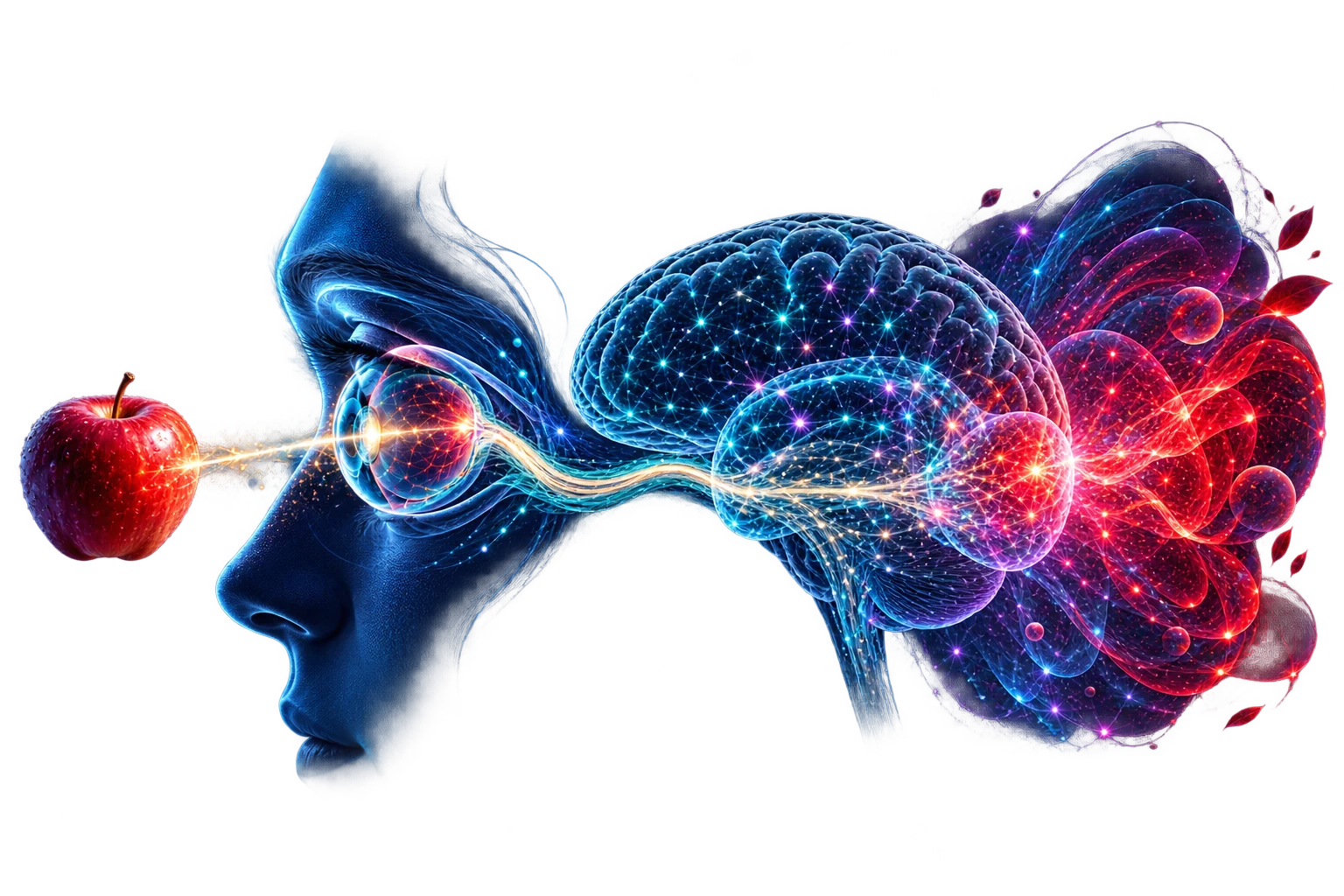
Third-person / the "easy" part: Light at roughly 700 nanometers reaches your retina, cone photoreceptors change their electrical response, retinal circuits relay signals through the thalamus to visual cortex, and your brain classifies the input as "red." Every step here is measurable with the right equipment.
The pathway from red light to visual processing can be measured. The felt redness of red is the subjective quality philosophers call qualia.
Meaning and science
What Does Consciousness Mean?
The meaning of consciousness changes slightly depending on who is using the word. In everyday speech, it can mean being awake or aware. In psychology, it may include attention, perception, memory, and the information available for thought or report. In neuroscience, researchers often study the brain activity associated with conscious awareness. Philosophy focuses closely on subjective experience: the fact that seeing red, tasting coffee, feeling pain, or having a thought has a felt quality from the inside.
This guide uses consciousness primarily in that last sense, sometimes called phenomenal consciousness. It is not offered as the only accepted consciousness definition. It is a practical way to separate human consciousness itself from the functions and behaviors that accompany it. A person can process information without becoming consciously aware of it, which is why awareness, attention, and conscious experience overlap without always meaning exactly the same thing.
How Does Consciousness Work?
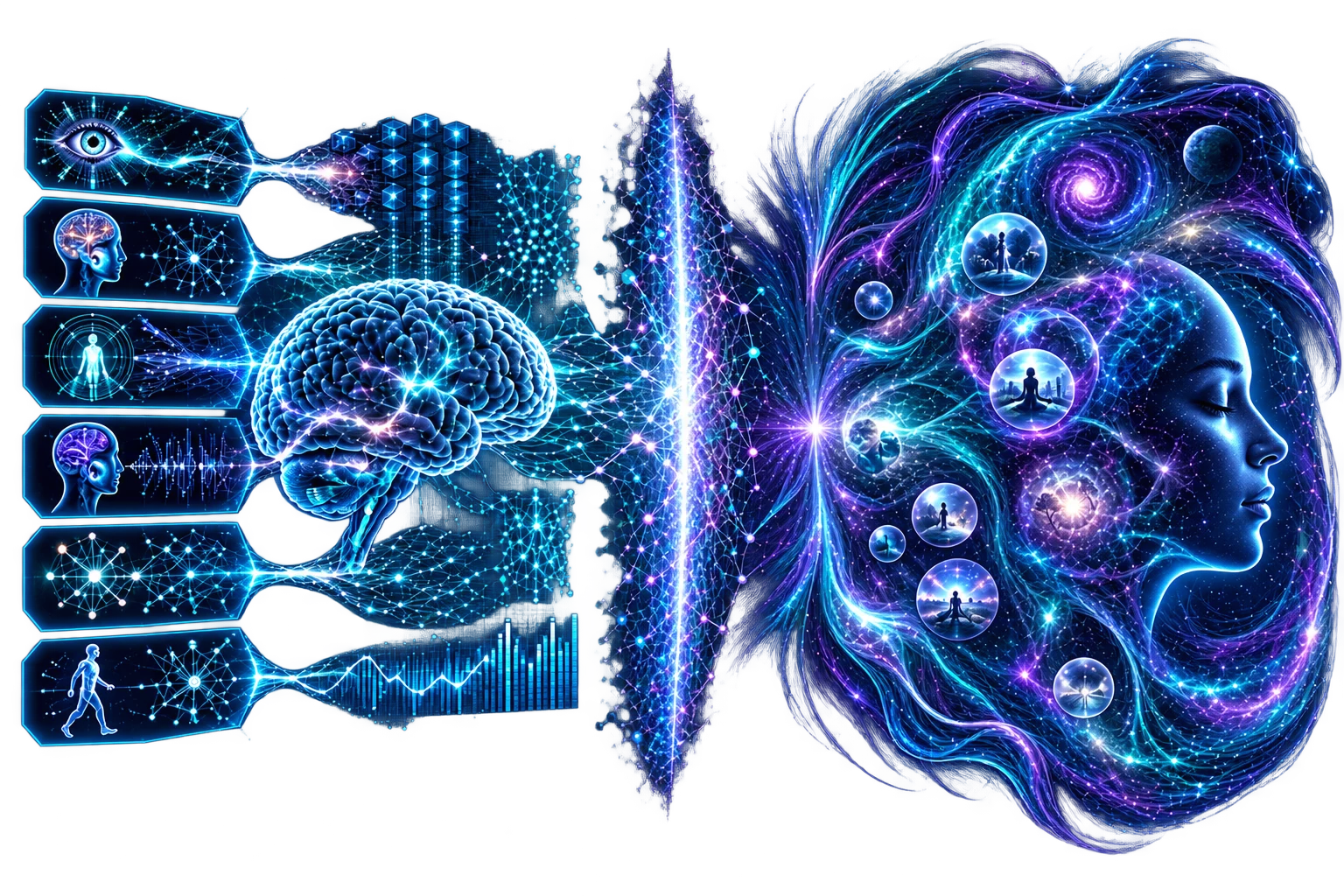
Researchers study consciousness by comparing what people experience or report with measurable changes in the brain. They investigate attention, sensory integration, wakefulness, working memory, and reportability, then look for the neural activity that reliably changes when conscious perception changes. These measurable relationships are called neural correlates of consciousness. They are especially useful in anesthesia, sleep research, and the diagnosis of patients who cannot communicate normally.
This work explains important parts of conscious processing, but a correlate is not automatically a complete cause or explanation. To see what neuroscience can test directly, explore how neuroscience studies the easy problems of consciousness. Researchers also build competing models of how brain activity becomes globally available, integrated, represented, or predicted. The leading theories of consciousness organize those ideas, but no single theory has won general acceptance.
Where Does Consciousness Come From?
Human conscious states strongly depend on the brain. Anesthesia can interrupt experience, brain injury can change it, and stimulation or disease can alter what a person sees, feels, or remembers. This evidence makes the brain central to any scientific account of human consciousness. It does not, however, prove that scientists have identified one place where consciousness begins or one mechanism that completely causes it.
The unresolved issue is how physical neural activity relates to felt experience. A complete map of brain processing could explain attention, memory, and behavior while leaving open the question of why any of that processing feels like something from the inside. That remaining explanatory gap is the hard problem of consciousness.
The easy problems ask how measurable brain functions work. The hard problem asks why any of that processing is accompanied by subjective experience.
Easy Problems vs the Hard Problem of Consciousness
Consciousness research contains two related but distinct projects. The easy problems examine functions that can be observed and tested, including attention, memory, sensory integration, wakefulness, and report. The hard problem asks why those physical and computational functions are accompanied by felt experience.
Processed EEG monitors are used in operating rooms to help clinicians assess anesthetic effect and reduce the risk of unintended awareness, particularly when movement cannot be used as a signal. This is consciousness research already embedded in clinical practice.
Established / active
Coma and vegetative state diagnosis
Tools such as the perturbational complexity index and covert command-following on fMRI can detect residual awareness in some unresponsive patients, informing diagnosis and care.
Active, regulated
Brain-computer interfaces
Brain-computer interfaces are being tested for speech and motor restoration. Their clinical progress depends on trial evidence, safety, and regulatory review.
Researchers identify measurable neural activity that tracks conscious states or contents. A correlate can support diagnosis and theory testing, but it does not by itself explain why experience exists.
A 2025 head-to-head test partially supported its account of what makes information reportable while also challenging parts of the model. It does not by itself explain why broadcasting information feels like anything.
This productive framework is widely used in perception research. It helps explain the structure and content of experience but does not directly settle the hard problem.
Some predictions received support in the 2025 adversarial test, while researchers continue to dispute the theory's testability and broader implications.
These theories are strong on metacognition and confidence but face debate over whether higher-order representation is necessary for every conscious experience.
As assessed in August 2026, no AI system was confirmed conscious by an accepted scientific standard, and proposed indicator frameworks remained probabilistic rather than decisive tests.
Panpsychism is a serious metaphysical position rather than an established empirical program. It remains influential partly because competing accounts have unresolved problems of their own.
Illusionism argues that the apparently irreducible character of experience may be a representation the brain constructs, making it a minority but rigorously argued physicalist position.
The 2025 field assessment identified major unresolved bottlenecks in brain recording, connectomics, structure-to-function inference, and validation. It did not provide a reliable date for human whole-brain emulation.
Cryonics can preserve physical structure, but no method has demonstrated restoration of a functioning human mind. It also raises the unresolved question of whether revival or copying preserves personal continuity.
Consciousness means having a subjective experience: there is something it feels like to see, hear, think, remember, feel pain, or be aware of yourself and the world. Researchers use the word in several ways, but this guide focuses on felt, first-person experience rather than behavior alone.
How does consciousness work?
Scientists study brain activity associated with attention, memory, wakefulness, sensory integration, and the ability to report an experience. These findings help explain the easy problems of conscious processing, while competing theories of consciousness try to explain how those functions fit together. No theory yet provides a generally accepted complete explanation.
Where does consciousness come from?
Human conscious states strongly depend on the brain: injury, sleep, anesthesia, and stimulation can all change experience. But scientists have not established exactly how physical brain activity produces subjective experience, so the origin of consciousness remains an open scientific and philosophical question.
Is consciousness the same as awareness?
The terms overlap, and everyday speech often treats them as synonyms. In technical work, awareness may refer to access to information or responsiveness, while consciousness may refer more broadly to subjective experience. Researchers do not use the distinction in exactly the same way across neuroscience, psychology, and philosophy.
Do scientists know what causes consciousness?
No generally accepted complete explanation exists. Researchers can identify brain processes associated with conscious states and test competing theories of consciousness, but the hard problem of consciousness remains: why should physical processing be accompanied by felt experience at all?
From the blog
Consciousness, one question at a time
Short, research-grounded articles will explore new studies, unresolved debates, and the ideas behind conscious experience.