What Are the Easy Problems of Consciousness?
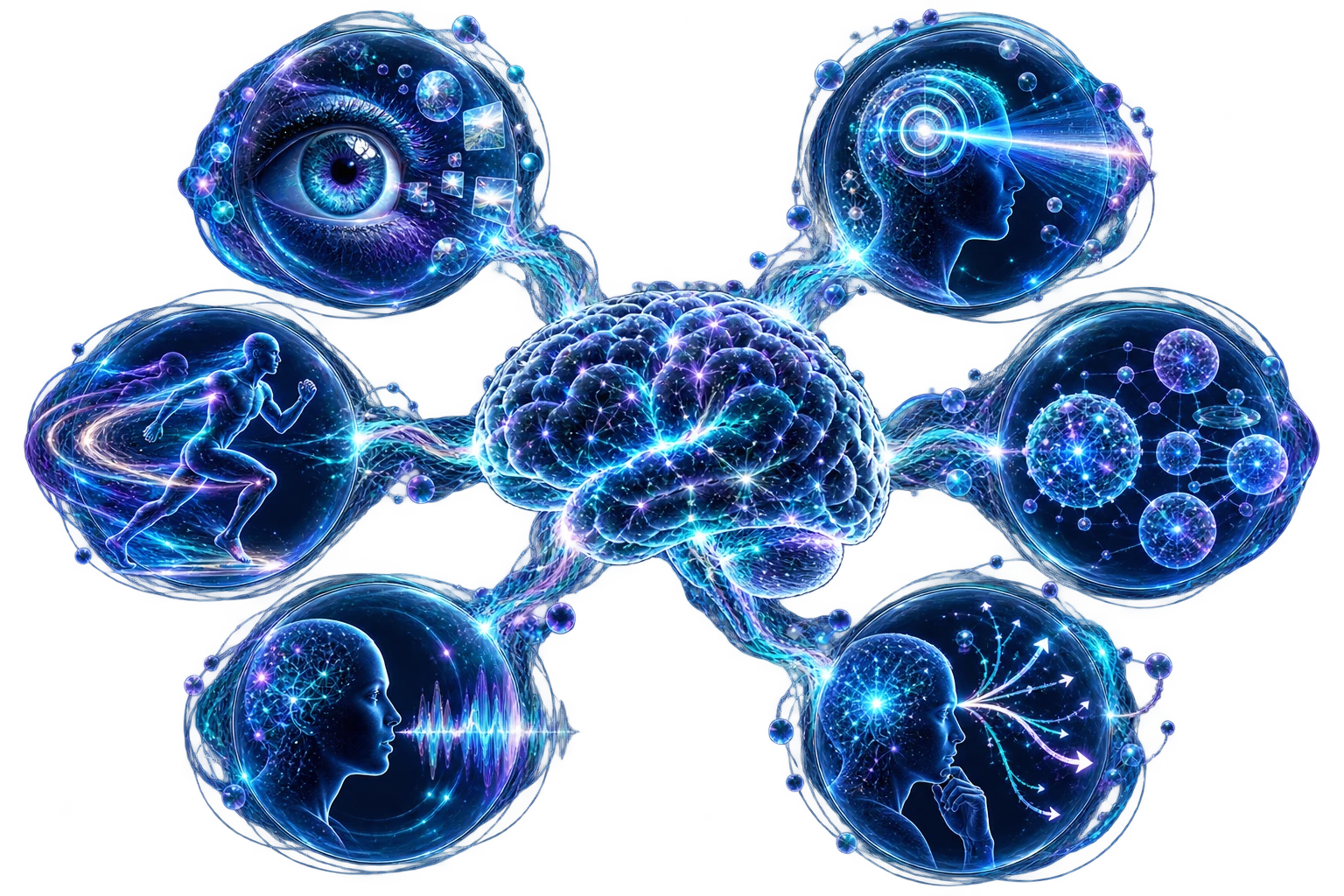
The easy problems of consciousness ask how the brain performs the functions associated with conscious awareness. These include selecting information through attention, holding it in working memory, integrating sensory signals, maintaining wakefulness, and making an experience available for report. They are questions about mechanisms and conscious processing that researchers can investigate through experiments, brain imaging, electrophysiology, and clinical observation.
Why "easy" is a strange word to use here
When David Chalmers introduced this term in 1995, he wasn't saying these problems are simple. He was making a narrower point: for each of them, we already know roughly what a solution would look like. Find the neurons, trace the circuit, model the computation. The path is hard to walk but easy to describe.
It's the difference between "how does an airplane generate lift" and "why does anything exist at all." The first is an enormously hard engineering and physics question, but you know the shape of the answer: air pressure, wing geometry, forces you can measure. The second doesn't even have an agreed shape for what an answer would be. The easy problems of consciousness are lift. The hard problem is the second question.
The main easy problems
Attention
How the brain picks one thing out of everything hitting your senses at once and processes it more deeply than the rest. Walk into a loud party and you can still track one conversation. That is attention doing selective filtering, and it helps researchers separate attention and consciousness instead of assuming they are identical.
Working memory
How the brain holds a small amount of information active for a short window, like remembering a phone number just long enough to dial it. This involves sustained firing patterns in prefrontal cortex that researchers can record directly.
Sensory integration
How sight, sound, touch, and the rest get combined into one coherent scene instead of arriving as separate, disconnected streams. When this breaks down, you get strange dissociations, like feeling a rubber hand is your own simply because you see it touched in sync with your real hand.
Wakefulness and arousal
The brain has clearly different states, deep sleep, dreaming, drowsy, alert, and each has a distinct signature in brain activity that can be measured and, increasingly, distinguished with real precision.
Reportability
The ability to say, out loud or to yourself, "I am seeing red right now." This sounds trivial but is actually one of the most useful tools researchers have, because it's the main way anyone can tell, from the outside, that something reached awareness at all.
Neural Correlates of Consciousness
Researchers often search for neural correlates of consciousness, commonly shortened to NCCs: the smallest measurable neural processes that reliably accompany a particular conscious state or conscious perception. Comparing seen and unseen stimuli, wakefulness and anesthesia, or reportable and unreportable information helps isolate which activity tracks awareness rather than general sensory processing.
Finding an NCC can improve diagnosis and test predictions from scientific theories of consciousness. It does not automatically explain why that neural activity produces felt experience. A correlate identifies a dependable relationship; the hard problem of consciousness asks why the relationship includes subjective experience at all.
Where this research already pays off
This isn't abstract. Easy-problem research is already doing real work in hospitals and labs:
- Anesthesia monitoring. Processed EEG monitors help clinicians assess anesthetic effect and reduce the risk of unintended awareness, particularly when muscle relaxants make movement unavailable as a warning sign.
- Diagnosing disorders of consciousness. Patients in a vegetative or minimally conscious state can sometimes be shown, through fMRI command-following tasks, to have more awareness than any bedside exam could detect. This has changed real diagnoses and real care decisions.
- Blindsight. Some patients with damage to visual cortex report seeing nothing, yet can accurately point to or "guess" the location of objects in their blind field far above chance. This split between what the brain processes and what a person can report has been a major clue in understanding what reportability actually requires.
- Split-brain studies. When the connection between the brain's two hemispheres is severed, each side can process information and act on it without the other "knowing," a striking demonstration of how much of what the brain does never reaches unified, reportable awareness at all.
Why solving all of these still wouldn't finish the job
This is the part that trips people up. You could, hypothetically, have a complete map of every easy problem, know exactly which circuits handle attention, memory, integration, and reporting, down to the last synapse, and you would still be able to ask the same question that started this whole field: why does any of that come with felt experience, instead of running the exact same computations with nobody home to feel them?
That is not a knock on easy-problem research. It is genuinely valuable, medically useful, and has already produced clinical tools. It is simply a different question from the one that gives the whole field its name.
Read the hard problem of consciousness explanation