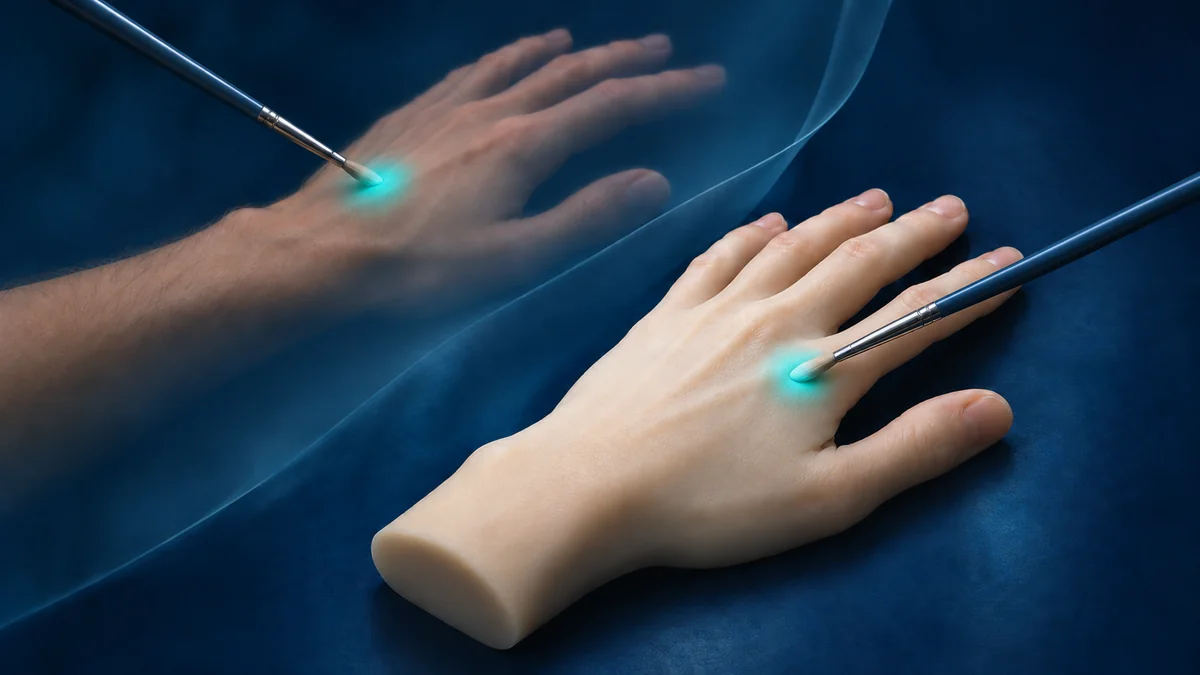
A rubber hand lies on a table. Your own hand is nearby, hidden behind a screen. Someone brushes both at matching locations and times while you watch the artificial one. After a while, something peculiar can happen: the touch seems to belong to the hand you can see, and that hand starts to feel like yours.
The object has not changed. Neither has your anatomy. What changes is an experience so familiar that it usually escapes notice: the feeling that a particular part of the world belongs to your body.
The rubber hand illusion gives researchers a manageable way to investigate that feeling. Its interest lies as much in the questions it separates as in the strange sensation itself.
The short answer
A rubber hand can feel like your own when information from sight, touch, and body position fits together in a convincing way. The leading explanation is that the perceptual system combines these signals into an interpretation of the body. Matching sensory events can make an artificial hand part of that interpretation.
This is evidence that bodily experience is flexible. It does not establish that the entire self is an illusion, that consciousness has moved into an object, or that scientists can transfer a person into another body. Researchers also disagree about how much expectations and the wording of questions contribute to the effect.
What happens in the experiment?
Matthew Botvinick and Jonathan Cohen described the classic experiment in their 1998 report in Nature. A visible artificial hand and a concealed real hand received corresponding touches. Participants reported unusual experiences of the artificial hand, and a reaching test examined where they located their own hand afterwards.
A common comparison uses mismatched timing: the participant sees a touch at a different moment from when they feel one. This helps researchers ask whether a relationship between the signals contributes to the illusion, rather than simply the presence of a realistic object.
The comparison needs careful interpretation. Changing the timing can also change what participants expect. And a laboratory effect describes a pattern across conditions and people, not a guarantee that everyone will have an identical experience.
Ownership, location, and control are different questions
Body ownership is the feeling that a body part is yours. Proprioception is your sense of where your body parts are and how they are positioned, including when you cannot see them. Agency is the experience of causing an action.
These ideas are easy to blur because ordinary voluntary movement brings them together. You raise a hand, feel it move, see it move, and experience it as your own. An experiment can pull these aspects apart.
- Ownership: Does that hand feel like part of my body?
- Location: Where do I feel my hand is?
- Agency: Do I feel that I am causing its movement?
- Referral of touch: Where does the touch seem to happen?
None is a complete definition of consciousness. Here, consciousness means subjective experience in general; ownership is one possible feature of its content. Personal identity, including whether you remain the same person over time, is a further question. A change in hand ownership does not answer it.
A pointing error is not an ownership meter
Researchers often measure proprioceptive drift: a shift in the reported position of the real hand towards the artificial one. It is an appealing measure because a pointing or location task supplies a number alongside a verbal report.
But a 2011 study by Marieke Rohde, Massimiliano Di Luca, and Marc Ernst found that drift and reported ownership could come apart. Under their experimental conditions, seeing the hand could affect location estimates without producing the same pattern of ownership ratings.
The implication is specific: drift alone cannot establish that someone felt ownership. It does not mean all location measurements are useless or unrelated to experience. It means that moving a numerical indicator and changing a particular feeling are not automatically the same result.
Imagine two participants making the same pointing error. One reports that the model felt like a bodily part; the other reports only uncertainty about where their concealed hand was. Treating their pointing scores as interchangeable experiences would erase exactly the distinction the experiment should investigate.
A hand can feel yours without feeling under your control
Andreas Kalckert and Henrik Ehrsson tested ownership and agency with a moving rubber hand in 2012. They varied whether movements were active or passive, whether real and model fingers moved together, and whether the model occupied a plausible bodily position.
Passive movement could preserve ownership while reducing the sense of causing the movement. Conversely, participants could report control over a model in an implausible position without experiencing it as part of their body. The experiment supports separating these dimensions rather than treating embodiment as one all-or-nothing switch.
A familiar analogy is operating a computer cursor. You can cause its movement without experiencing it as a bodily part. That analogy illustrates the distinction; it does not imply that every mechanism behind cursor control and bodily agency is identical.
What brain measurements add
In a 2004 functional MRI study, Ehrsson, Charles Spence, and Richard Passingham examined brain activity while manipulating the rubber hand illusion. Activity in the premotor cortex reflected the feeling of ownership. The authors interpreted this as evidence for a contribution from the integration of multiple senses.
That adds a biological observation to subjective reports. It does not identify a single place where the whole self lives. Nor does an association between activity and an experience, on its own, explain how the experience arises.
This is the same caution needed elsewhere in consciousness research: measuring a correlate is useful, but the interpretation depends on what the experiment changed and what it actually measured. A brain scan is not a photograph of a feeling.
How uncertain signals can change the result
One proposed explanation treats body ownership as a problem of inference. Do the things seen and felt have a common cause, such as one hand being touched? Or do they belong to separate events? Researchers can express this question in a mathematical model without suggesting that participants consciously perform calculations.
In a 2023 experiment, Marie Chancel and Ehrsson used tendon vibration to make proprioceptive signals less reliable while varying the timing of seen and felt touches. Ownership reports became more likely under increased proprioceptive uncertainty. A Bayesian causal-inference model fitted the pattern.
The result supports the idea that reliability matters, alongside whether signals match. The model offers an account of those judgements, not a demonstration that all bodily experience follows one equation. The researchers also discuss earlier findings that questioned the role of proprioceptive reliability, using different methods.
Could people experience what they expect?
There is a serious alternative emphasis. Participants may infer what a study is supposed to produce, and their expectations may influence what they experience or report. This is not equivalent to accusing them of lying.
In a 2020 paper, Peter Lush and colleagues reported relationships between hypnotisability and experimental changes in experience, including the rubber hand illusion. They argued that a capacity to generate experiences in line with expectations, which they call phenomenological control, could account for such findings.
Mel Slater and Ehrsson reanalysed the rubber-hand data in 2022. They found that the synchronous condition produced stronger illusion ratings across levels of hypnotisability. Their models gave multisensory stimulation a larger role than suggestibility, with measured expectations contributing little.
These are competing analyses of shared data, not two independent replications. The disagreement concerns explanation and measurement: how to separate sensory integration, expectations, individual differences, and reports. It would overstate the evidence to say either that suggestion explains everything or that expectations can simply be ignored.
Better questions reveal a less tidy illusion
The questionnaire itself is part of the instrument. Giorgia Tosi and colleagues analysed questionnaire data in 2024 and found reasons to distinguish ownership from the apparent location or origin of touch. These were closely related, but not necessarily interchangeable. Even control statements could vary with the illusion.
A useful lesson for readers is to look beyond a headline saying that an illusion became stronger. Which answer changed? Did the participant locate a sensation differently, endorse ownership more strongly, or report something else? Combining answers can be convenient, but it can also hide meaningful differences.
A 2026 analysis by Renzo Lanfranco and colleagues approached another distinction using a two-rubber-hand task. Participants selected which model felt more like their own while researchers varied visual access to approaching probes and touch events. Removing predictive visual information changed a bias in ownership judgements without reducing sensitivity to synchrony when touch timing remained visible or inferable.
In plain language, a tendency to select one hand and an ability to distinguish sensory timing need not change together. Published on April 1, 2026, the work reanalysed existing datasets. It refines an explanation of experimental judgements; it is not a discovery that researchers can redirect a whole person into an artificial body.
Even the apparent rules have exceptions
Matching posture and touch locations is a useful starting point, but rigid claims about what is impossible can be premature. Nicholas Christos and colleagues reported a striking variant in 2025: participants watched a left rubber palm being touched while touches were delivered to the back of their concealed right hand.
Nine of ten naive participants reported ownership and visual capture of touch during synchronous stimulation. This small demonstration suggests that some mismatches can coexist with the illusion. It does not show that anatomical constraints never matter or that the result applies to everyone. Its small, all-female sample also limits broad conclusions.
For an educational account, the right response is to retain both findings: sensory relationships constrain body ownership, and the exact constraints need experimental testing. An exception helps improve an explanation; it need not erase the entire research programme.
From rubber hands to virtual bodies
The visible limb does not have to be a physical prop. In a 2008 virtual-arm experiment, Slater and colleagues paired touches on a hidden real hand with corresponding visual events on a computer-generated arm. Their findings supported an illusion of ownership under synchronous stimulation compared with asynchronous stimulation.
The study used small groups of male participants and a specific virtual-reality setup. It established a possibility under those conditions, not a universal recipe for embodiment. Nevertheless, it makes the future-facing question concrete: how might virtual interfaces provide sensory feedback that feels coherent with a user's body?
That is different from mind uploading. Feeling that an avatar's hand belongs to you is a change in the experience of a living participant. It does not show that memories, consciousness, or personal identity have been transferred into software.
The broader philosophical puzzle also remains. These experiments investigate how bodily experience changes with sensory conditions. They do not settle the hard problem of consciousness, the question of why physical processes are accompanied by subjective experience at all.
What they offer is more precise: the boundary of the experienced body is something scientists can probe, with separate questions about ownership, location, control, and expectation. Keeping those questions distinct makes the results more revealing, and less vulnerable to exaggerated claims.
Common questions
Does the rubber hand become conscious?
No evidence here suggests that. The reported experience belongs to the human participant. The artificial hand supplies visual information within an experiment; it is not shown to have sensations of its own.
Does everyone experience the illusion?
No. Reports vary across participants and experimental conditions. A weak or absent response does not, by itself, establish anything about someone's intelligence, imagination, or mental health.
Does this prove the self is unreal?
No. It shows that aspects of bodily experience can be altered. Whether that supports a particular philosophical account of the self requires arguments beyond the experiment.
Could a virtual body feel like mine?
Virtual-limb research supports that possibility under suitable sensory conditions. It is evidence about embodiment, not evidence that a person has moved out of their biological brain.
Sources and further reading
Direct research sources are linked beside the claims they support. The reading list includes original experiments and explicitly identified reanalyses; no preprints are used.
- Botvinick and Cohen, 1998, Nature. The classic rubber hand report.
- Rohde, Di Luca, and Ernst, 2011, PLOS ONE. Ownership and proprioceptive drift.
- Kalckert and Ehrsson, 2012, Frontiers in Human Neuroscience. Ownership and agency.
- Ehrsson, Spence, and Passingham, 2004, Science. Premotor activity and ownership.
- Chancel and Ehrsson, 2023, Cortex. Proprioceptive uncertainty.
- Lush and colleagues, 2020, Nature Communications. Phenomenological control.
- Slater and Ehrsson, 2022, Frontiers in Human Neuroscience. Reanalysis of multisensory and expectation effects.
- Tosi and colleagues, 2024, Attention, Perception, & Psychophysics. Questionnaire structure.
- Lanfranco and colleagues, 2026, Royal Society Open Science. Reanalysis separating sensitivity and bias.
- Christos and colleagues, 2025, i-Perception. The mismatched-palm variant.
- Slater and colleagues, 2008, Frontiers in Human Neuroscience. Virtual-arm ownership.