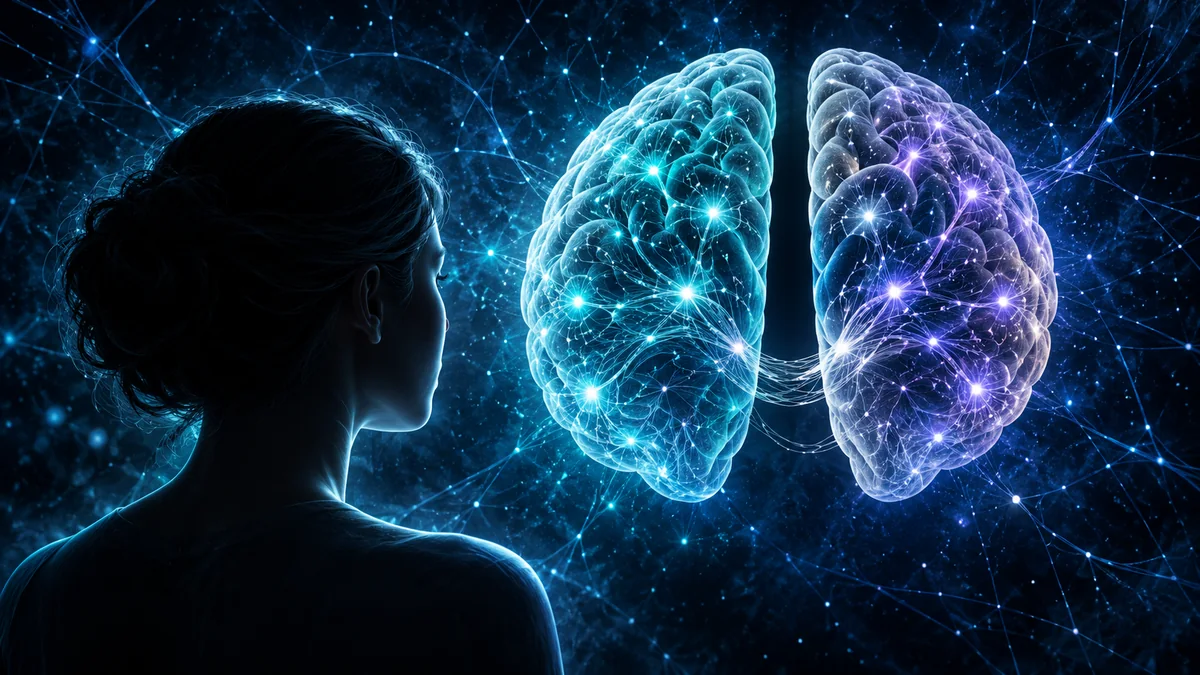
In a split-brain operation, surgeons cut the main bridge between the brain's hemispheres to limit the spread of severe epilepsy. The result created one of neuroscience's strangest questions: if the hemispheres can no longer share much of their information, does one person become two conscious minds?
The classic experiments make that possibility feel almost unavoidable. A patient may be unable to name an object shown only to the right hemisphere, yet can select that object with the left hand. One side appears to know something the speaking side does not. But the conclusion is not as simple as the demonstration. Later studies found forms of unified detection, action, and deliberate communication that survive the surgery.
What is a split brain?
The left and right cerebral hemispheres normally exchange information through bundles of nerve fibres. The largest is the corpus callosum. In a callosotomy, some or all of this bundle is cut. More extensive historical operations, often called commissurotomies, also divided other connections between the hemispheres.
These operations were not designed as consciousness experiments. They were treatments for people with severe seizures that had not responded to other approaches. By interrupting communication between the hemispheres, surgeons could reduce the spread of seizure activity. The research opportunity came afterward, when scientists tested what the separated hemispheres could perceive and report.
The phrase "split brain" can also hide important differences. Patients may have complete or partial sections, different surgical histories, different neurological conditions, and decades of adaptation. Results from one rare patient cannot automatically describe every person who had the procedure.
Why the classic experiments looked like two minds
Vision is arranged in a way that makes the split visible. Information briefly shown to the right of fixation is processed mainly by the left hemisphere. Information shown to the left goes mainly to the right hemisphere. In most people, the hemispheres rapidly share what they receive. After a complete callosal section, that exchange is greatly reduced.
Speech is usually controlled mainly by the left hemisphere. In foundational work, Roger Sperry, Michael Gazzaniga, and colleagues found that some patients could name an item shown to the left hemisphere but could not name one shown only to the right. The apparent failure did not mean the right hemisphere saw nothing. With the left hand, which is controlled mainly by the right hemisphere, a patient could sometimes point to or retrieve the correct object.
This creates a striking dissociation. The speaking hemisphere says it did not see the object, while the other hemisphere guides a correct response. Later experiments found deep separations in visual recognition, language, and learned information. A 1987 study also found an important qualification: perceptual and cognitive information was strongly divided, but aspects of attention remained integrated.
The pattern inspired talk of two streams of awareness inside one skull. It is a reasonable hypothesis. Each hemisphere can receive different evidence and support a different response. Yet a different response is not automatically a different subject of experience. Experiments measure reports and actions. Consciousness is the interpretation placed on those measurements.
What is actually divided?
It helps to separate four questions that are often blended together.
- Perception: Can information presented to one hemisphere affect processing in the other?
- Access: Can the person use that information for a comparison, decision, or verbal report?
- Control: Can each hemisphere guide a different hand or response?
- Subjectivity: Are there one or two centres of felt experience?
The first three can be tested with controlled tasks. The fourth is harder because no instrument directly counts subjects of experience. If the left hand chooses correctly while speech fails, the result establishes divided access and response. Saying that a second conscious person made the choice adds a philosophical and scientific interpretation.
The division is not absolute even at the behavioural level. Some information may travel through smaller pathways that remain intact. The hemispheres can also use the body and environment as communication channels. A small head movement, eye movement, sound, or strategy can pass a clue from one side to the other. Researchers call this cross-cueing. Some motor control is also less strictly lateralized than a simple textbook diagram suggests.
That is why careful experiments must control fixation, response hand, eye movement, practice, and alternative routes. A surprising success may reveal preserved integration, but it may instead reveal a clever workaround. A surprising failure may reveal disconnection, but it may also reflect task demands or language limits.
What newer experiments changed
In 2017, Yair Pinto and colleagues tested two patients whose corpus callosum had been completely divided. The patients struggled to compare stimuli presented across the two visual fields, which confirmed a major loss of visual integration. Yet they could report the presence, location, orientation, or identity of stimuli from either side of space, using either hand or speech in many conditions. Confidence ratings also suggested awareness across the full visual field.
The researchers proposed a provocative interpretation: visual processing was divided, but the conscious perceiver remained unified. On this view, consciousness does not simply split wherever cortical communication splits.
That conclusion was challenged. Michael Gazzaniga and colleagues argued in 2018 that the behaviour could be explained by cross-cueing, control of both hands from one hemisphere, or information moving through subcortical pathways. They accepted the unusual abilities but disputed what those abilities established about a single consciousness.
Touch produced a similarly mixed result. In a 2020 study, split-brain patients could detect and locate a touch on either side of the body with either hand. However, they had difficulty comparing two touches placed on opposite sides. Detection looked unified, while direct integration across sides remained impaired.
A 2023 visual study added another layer. One patient performed poorly when information on opposite sides had to be integrated automatically across fixation. When given time and an explicit instruction to combine information in a deliberate sequence, the patient performed much better. The authors suggested that a fast automatic route had been lost while a slower, strategic route remained available.
These results do not erase the classic findings. They make the architecture more complicated. Separation depends on the information, task, timing, response, and strategy. A split brain is not two sealed computers. It is a biological system with damaged highways, surviving side roads, and a lifetime of adaptation.
So is there one consciousness or two?
There are at least three serious possibilities.
Two conscious systems. Each hemisphere may support its own experiences, goals, and knowledge. The speaking hemisphere dominates ordinary conversation, so the other stream is difficult to hear. Classic lateralized responses fit this picture well.
One conscious person with divided access. The person's experience may remain unified even though particular contents cannot reach every reporting or action system. Modern findings of cross-field detection and flexible response fit this view, though critics question the mechanisms.
A more fragmented arrangement. Consciousness may not have a fixed count. The patient could retain one practical self while particular processes temporarily operate with unusual independence. Asking whether the answer is exactly one or exactly two may impose a cleaner boundary than the brain provides.
A 2020 review of the field found broad agreement that the operation disrupts integration in perception and attention, while noting that action control can remain surprisingly unified. The authors argued that the major dispute now concerns how to interpret a shared set of behavioural facts. A 2025 clinical review captured the same tension: experiments reveal lasting disconnection between distinct neural systems, but patients generally appear unified in everyday life.
The cautious answer is therefore not a dramatic number. There is strong evidence for divided processing and limited evidence for how many subjects of experience exist. Two response systems are observable. Two conscious beings remain an inference.
Why can daily life look so normal?
Outside a laboratory, both hemispheres usually receive similar information. A person can move their eyes, turn their head, speak aloud, and use environmental cues. The carefully separated visual flashes used in experiments are rare in ordinary life. Shared subcortical systems, habits, and the body provide further coordination.
The speaking left hemisphere may also create a coherent account from incomplete evidence. Gazzaniga called this explanatory tendency the interpreter. It can make behaviour feel more unified than the information behind it. Importantly, the interpreter is not proof that the non-speaking hemisphere lacks experience. It is a model of how one system constructs reasons and narrative.
Adaptation matters too. Many research participants lived for years after surgery and learned strategies that early tests may not reveal. Clinical normality and experimental division are not contradictory. They describe the same person under different information conditions.
What split-brain research teaches about consciousness
First, consciousness cannot be read directly from speech. A system may guide an accurate action without being able to produce a verbal explanation. This lesson reaches beyond split-brain research to infants, non-human animals, neurological patients, and possible artificial systems.
Second, unity has several meanings. Information can be unified for seeing, comparing, choosing, moving, remembering, or narrating. These forms of unity can come apart. A theory of consciousness must say which kind it explains.
Third, the brain can support a coherent person without making every piece of information globally available. The everyday self may be a coordinated achievement rather than the output of one indivisible command centre.
Finally, rare neurological cases require humility. Samples are tiny because the operation is uncommon, and patients differ. The most interesting claims often rely on a handful of people tested repeatedly over many years. These studies can falsify simple theories, but they rarely justify sweeping certainty on their own.
The questions still open
Researchers still need better ways to distinguish genuine interhemispheric transfer from cross-cueing and motor workarounds. More detailed imaging can establish which connections remain. Carefully designed tasks can compare automatic processing with deliberate strategies. Long-term records can show how compensation develops.
The deeper challenge is conceptual. What evidence would count as one subject rather than two? Agreement between hands is not enough, because two agents can cooperate. Conflict is not enough either, because one ordinary mind can contain competing goals. Any decisive test needs a theory connecting behaviour, neural organization, and subjective experience.
Split-brain research has not delivered the simple verdict that one person becomes two. It has delivered something more useful: a demonstration that the unity of mind has parts. Perception, report, action, memory, and self-narrative can separate without the person neatly dividing along the same line.
Common questions
Does split-brain surgery create two personalities?
No. The experiments reveal separated information and response systems, not a standard pattern of two personalities. Most patients appear socially and personally unified in everyday life.
Can the two hemispheres disagree?
They can support different answers when each receives different information. Some experiments produce conflicting hand choices or a verbal answer that differs from a nonverbal response. The frequency and meaning of such conflicts depend heavily on the task.
Can the hemispheres communicate after the operation?
Some communication and coordination can remain through spared neural pathways, subcortical systems, the body, and environmental cues. A complete callosal section removes the largest bridge, not every possible route.
Are split-brain operations still performed?
Corpus callosotomy remains a treatment option in selected cases of severe drug-resistant epilepsy, often using partial or staged procedures. Individual medical decisions require specialist evaluation and are outside the scope of this educational article.
What is the safest conclusion from the research?
The operation can divide access to information much more clearly than it divides the person. Claims about exactly one or two conscious subjects remain scientifically and philosophically contested.
Sources and further reading
Gazzaniga and Sperry, 1967, Brain. Foundational language experiments after cerebral commissure section.
Gazzaniga and colleagues, 1987, Neuropsychologia. Experimental comparison of divided perception and partly integrated attention.
Gazzaniga, 2000, Brain. Review of cerebral specialization and interhemispheric communication.
Pinto and colleagues, 2017, Brain. Evidence interpreted as divided visual perception with unified consciousness.
Volz and colleagues, 2018, Brain. Alternative explanations involving motor control, cross-cueing, and preserved transfer.
de Haan and colleagues, 2020, Cortex. Tactile detection and localization across both sides of the body.
de Haan and colleagues, 2020, Neuropsychology Review. Review of the empirical common ground and competing interpretations.
Pinto and colleagues, 2023, Frontiers in Human Neuroscience. Single-patient experiments comparing automatic and deliberate visual integration.
Miller and colleagues, 2025, Handbook of Clinical Neurology. Recent clinical and experimental perspective on lasting disconnection and apparent unity.