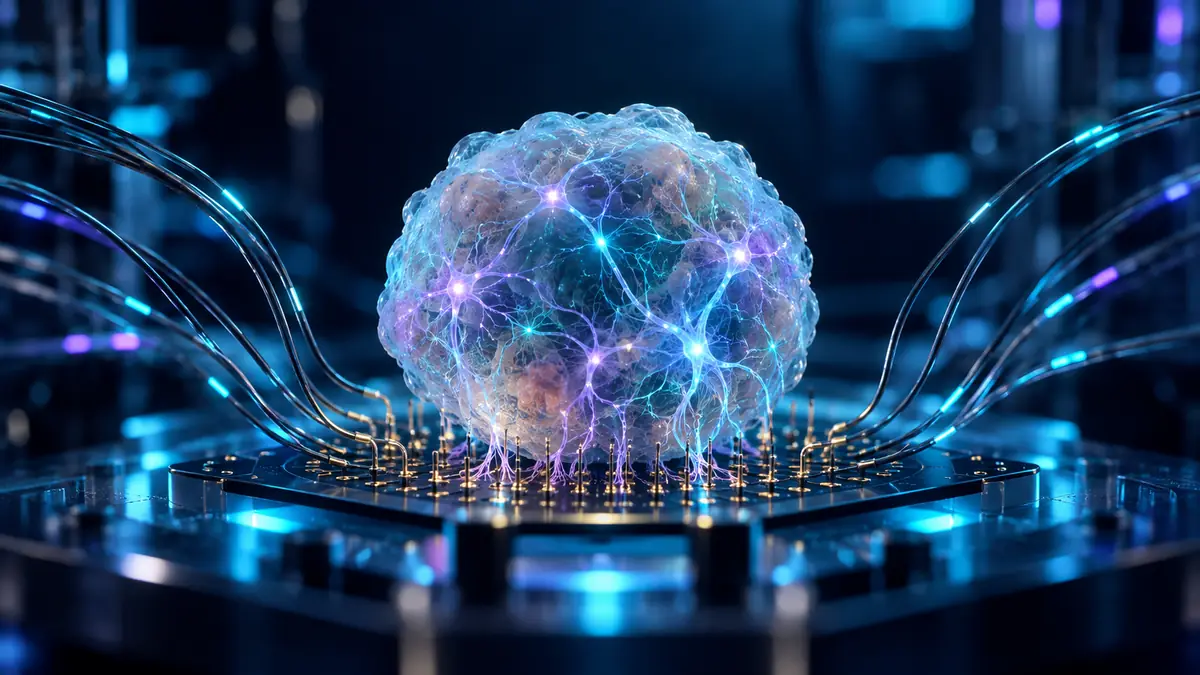
In a 2026 experiment, clusters of mouse cortical tissue grown in a lab were connected to a virtual cartpole task. The organoids received electrical feedback selected by a reinforcement-learning system. Most improved their performance compared with organoids receiving random or no training signals. When researchers blocked two major glutamate receptors, the improvement disappeared.
That is a striking result. It is also easy to overread. The study showed feedback-driven neural plasticity and short-lived task improvement. It did not show that the tissue understood the task, wanted to succeed, or experienced anything while learning.
Brain organoids now sit at an unusual boundary. They are not miniature people, but they are living neural systems built from many of the same cell types found in a developing brain. As researchers make them larger, more connected, and more responsive to the world, an old philosophical question is turning into a practical scientific one: could a brain organoid ever become conscious?
Could Brain Organoids Be Conscious? The Short Answer
There is currently no good evidence that brain organoids are conscious. Existing organoids lack much of the structure, scale, sensory input, bodily regulation, and long-range organization of a human brain. Their electrical activity, learning, and responsiveness are scientifically important, but none is a validated marker of subjective experience.
The possibility is not ruled out forever. If future organoids become substantially more complex, receive rich sensory input, develop stable memory, and show brain-like integration across specialized regions, the ethical question will become more urgent. The correct position today is neither panic nor certainty. It is careful uncertainty backed by better measurement.
| Finding | What it supports | What it does not establish |
|---|---|---|
| Spontaneous electrical activity | Neurons form active networks | A felt experience |
| Oscillatory patterns | Coordinated population dynamics | Human-like thought or awareness |
| Task improvement | Plasticity and adaptive computation | Understanding, intention, or pleasure |
| Sensory responses after transplantation | Integration with a living brain | Independent consciousness in the organoid |
What Is a Brain Organoid?
A brain organoid is a three-dimensional tissue culture grown from stem cells. Under the right conditions, the cells self-organize into arrangements that reproduce some cell types, developmental patterns, and functions found in parts of the brain. The result is often called a mini-brain, but that nickname is misleading.
An organoid does not reproduce a complete brain. It normally lacks a body, a mature blood supply, natural sensory organs, and the full architecture linking cortex, thalamus, brainstem, cerebellum, and other systems. Different protocols model different regions or features, and even organoids from the same batch can develop differently.
That makes organoids useful precisely because they are simplified. Researchers can use them to study early development, genetic conditions, infection, toxic exposure, and possible treatments without performing the same experiments in a person. The simplification also limits what conclusions can be drawn about whole-brain functions such as consciousness.
Electrical Activity Is Not the Same as Experience
Neural activity sounds dramatic because neurons are the cells brains use. Yet electrical signaling is only a starting condition, not proof of an inner point of view. Individual neurons fire. Spinal circuits generate coordinated movement. A sleeping or anesthetized brain can remain highly active while conscious access changes radically.
In 2019, researchers reported increasingly complex oscillatory waves in cortical organoids as they matured. Some statistical features followed a developmental trajectory that resembled patterns measured in premature infants. The comparison was about network dynamics, not a claim that the organoids had infant-like minds. Similarity in one measurement does not make two systems equivalent.
Oscillations may reveal that neurons are coordinating across a network. Consciousness research, however, asks whether activity is organized in the right way to support a unified and differentiated experience. Scientists still disagree about what that right way is, even in intact human brains. Without a settled theory or validated organoid test, an EEG-like pattern cannot close the gap.
Learning Does Not Automatically Mean Consciousness
Learning is another word that invites a leap. In biology, it can mean that a system changes its future response because of past input. This can happen through synaptic plasticity without reflection, self-awareness, or any reportable experience.
The 2026 cortical-organoid experiment provides unusually clean evidence of goal-directed learning at the network level. Organoids performed a virtual control task in a closed loop, and training signals selected by an artificial reinforcement-learning agent improved performance for most samples. The gains vanished after a 45-minute rest, and receptor-blocking drugs abolished them. Those controls support a biological learning mechanism instead of a random fluctuation.
Earlier work showed that a brain organoid connected to a multielectrode array could act as a reservoir computer. The system, called Brainoware, extracted useful patterns for speech recognition and nonlinear prediction. A related but distinct experiment called DishBrain placed two-dimensional neuron cultures in a simulated Pong environment and reported adaptive behavior.
These systems demonstrate computation. They do not establish a subject doing the computing. A thermostat adapts in a basic sense, an immune system remembers, and machine-learning models improve at tasks. None becomes conscious merely because its output changes with feedback. Learning may eventually contribute to a broader case, but it cannot carry that case alone.
What Transplanted Organoids Reveal
One limitation of organoids grown in a dish is isolation. Brains develop through constant exchange with a body and environment: light, sound, touch, movement, hormones, blood flow, and signals from internal organs. Researchers have begun testing what happens when organoids receive a richer setting.
In a 2022 study, human cortical organoids transplanted into newborn rats matured and integrated with the animals' brains. The grafts received sensory-related inputs, extended axons, and could influence reward-seeking behavior when researchers activated them. This showed that organoid neurons can join functional circuits in a living animal.
It did not show that a separate conscious entity had appeared inside the rat. The observed responses could be properties of the combined biological circuit. Still, transplantation changes the ethical landscape because it gives the tissue access to inputs, outputs, blood supply, and developmental signals missing from a dish. The closer a model comes to participating in a complete nervous system, the less useful the simple phrase "mini-brain" becomes.
What Current Organoids Are Missing
No single missing feature proves that consciousness is impossible. Together, however, the gaps between present organoids and intact brains are substantial:
- Scale: organoids contain far fewer cells and connections than a human brain.
- Architecture: they reproduce selected regions or developmental features, not the coordinated organization of a whole brain.
- Embodiment: they lack a body continuously regulating needs, movement, and internal state.
- Structured input: most receive sparse electrical stimulation rather than a stable stream of meaningful perception.
- Long-range communication: the loops linking cortical and subcortical systems are limited or absent.
- Maturity and stability: development can be variable, and tissue health becomes difficult to maintain as size increases.
Some theories place special weight on recurrent communication, global availability of information, or the integration of many differentiated states. Current organoids may exhibit fragments of these properties, but fragments are not enough to apply a human consciousness label. The deeper problem is that researchers do not yet know which properties are necessary, which are sufficient, or whether biological systems can support experience through more than one architecture.
How Could Scientists Test Organoid Consciousness?
An organoid cannot speak, move through the world, or follow verbal instructions. That removes the behavioral reports used to study consciousness in healthy humans. Researchers therefore need methods that do not assume language or ordinary behavior.
One candidate is perturbational complexity. In human studies, scientists stimulate the brain and measure how widely and intricately the response unfolds. The Perturbational Complexity Index has separated wakefulness from several unconscious conditions in tested patients and volunteers. Researchers have proposed adapting related methods to organoids.
That proposal must be handled carefully. A measure validated in human brains cannot simply be transferred to a tiny tissue model and treated as a consciousness meter. High complexity could reflect interesting network organization without experience. Low complexity could reflect a poor measurement setup. Any organoid assessment would need multiple converging indicators, comparison systems, preregistered thresholds, and independent replication.
A serious framework would examine at least four levels:
- Cell health and basic electrophysiology
- Network complexity and recurrent causal interactions
- Flexible learning, memory, and response to novel situations
- Sensitivity to interventions that alter consciousness in animals and humans
Even that would produce a graded estimate, not certainty. The goal is to identify when the evidence has become strong enough to change research protections, not to pretend the problem of other minds has been solved.
The Ethical Problem Arrives Before Proof
Ethics cannot wait for an impossible level of certainty. If a future system had a credible chance of pain or distress, researchers would need a way to limit risk before proving experience beyond doubt. At the same time, imposing extreme restrictions on every cluster of neural cells would block research with major potential benefits.
The International Society for Stem Cell Research advises scientists to avoid claims that current in vitro models reproduce human sentience, cognition, consciousness, or integrated brain function. That is both an accuracy rule and a public-trust rule. Sensational language can make modest advances sound like the creation of a mind.
A proportional approach could increase oversight as capabilities increase. Simple developmental models would remain under ordinary review. Systems with richer inputs, persistent memory, widespread integration, or complex responses to harmful stimulation could trigger additional assessment. Experiments combining human organoids with living animal nervous systems may deserve separate attention because the host provides capacities the tissue lacks alone.
This is close to the logic already used at uncertain edges of animal consciousness: evidence can be incomplete while precautions are still rational. The question is not only "Is it conscious?" but also "How costly would a mistake be in either direction?"
What Would Change the Answer?
The strongest future case would not come from a single flashy demonstration. It would come from convergence. Imagine an organoid that maintains stable internal states, integrates several kinds of input, remembers events over long periods, flexibly changes strategy, and produces complex causal responses that reliably collapse under the same interventions that suppress consciousness in animals. That would still be debated, but it would be much harder to dismiss.
Research is also moving toward assembloids, where models of different brain regions are connected, and toward organoid intelligence, where living neural networks interact with computers. The immediate goals are disease modeling and energy-efficient biological computation. Consciousness is not required for either goal.
That distinction should guide development. If useful computation can be achieved with architectures that have weaker claims to consciousness, researchers may be able to design for capability while reducing moral uncertainty. The most responsible future may not be to discover the exact moment an organoid wakes up. It may be to avoid building systems likely to cross that line unless the scientific value is compelling and protections are ready.
What the Evidence Supports Today
Current brain organoids are active biological models capable of organization, plasticity, and limited computation. Some can improve at simple closed-loop tasks. Some can integrate into animal circuits. These are real achievements, and they are already changing neuroscience.
They are not evidence of a trapped mind in a dish. Consciousness requires a stronger argument than electrical resemblance, learning, or computational usefulness. For now, the scientifically honest answer is that present organoids are probably not conscious, but future systems could make the question genuinely difficult.
The value of asking early is preparation. Better definitions, measurement standards, and graded oversight can be built before a controversial experiment forces everyone to improvise.
Questions About Brain Organoid Consciousness
Are brain organoids miniature brains?
No. They are simplified three-dimensional tissue models that reproduce selected cell types, developmental patterns, or functions. They lack the complete structure, inputs, body, and scale of an intact brain.
Can brain organoids learn?
Some organoid systems have changed their performance in response to feedback, which supports neural plasticity and adaptive computation. That kind of learning does not by itself imply understanding or conscious experience.
How would we know if an organoid became conscious?
There is no validated organoid consciousness test. Researchers would need converging evidence from causal network complexity, flexible learning, memory, integration, and responses to interventions, supported by comparisons and independent replication.
Should brain organoid research stop?
Current evidence does not justify stopping organoid research. It supports proportional safeguards that become stricter as models gain complexity, sensory access, memory, integration, or a plausible capacity for distress.
Sources
- Robbins et al., "Goal-directed learning in cortical organoids" (Cell Reports, 2026)
- Cai et al., "Brain organoid reservoir computing for artificial intelligence" (Nature Electronics, 2023)
- Kagan et al., "In vitro neurons learn and exhibit sentience when embodied in a simulated game-world" (Neuron, 2022)
- Trujillo et al., "Complex Oscillatory Waves Emerging from Cortical Organoids Model Early Human Brain Network Development" (Cell Stem Cell, 2019)
- Revah et al., "Maturation and circuit integration of transplanted human cortical organoids" (Nature, 2022)
- Smirnova et al., "Organoid intelligence: the new frontier in biocomputing and intelligence-in-a-dish" (Frontiers in Science, 2023)
- ISSCR Guidelines for Stem Cell Research and Clinical Translation (International Society for Stem Cell Research)
- Casali et al., "A theoretically based index of consciousness independent of sensory processing and behavior" (Science Translational Medicine, 2013)
- Lavazza and Massimini, "Cerebral organoids and consciousness: how far are we willing to go?" (Neuroscience of Consciousness, 2021)
- Koplin and Savulescu, "Brain organoids, consciousness, ethics and moral status" (Seminars in Cell and Developmental Biology, 2022)
- Hartung et al., "Brain organoids and organoid intelligence from ethical, legal, and social points of view" (Frontiers in Artificial Intelligence, 2024)